24 March, 2026
Shetlanders asked to get out and count their local drummiebees
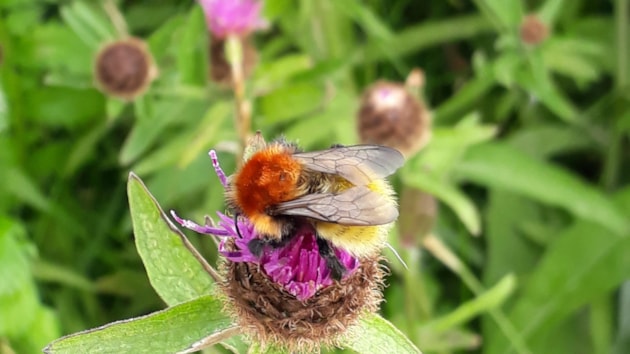
Conservation programme Species on the Edge is calling on people across Shetland to take part in Britain’s most northerly BeeWalks, a volunteer survey scheme run by the Bumblebee Conservation Trust.
Bumblebees in Britain have suffered dramatic declines over the past century. The BeeWalk scheme sees volunteers across Britain take part in monthly walks between March and October, walking a set route of up to 2km long and recording the bumblebees seen on their way. The data collected helps identify species that are struggling, areas where populations are changing, and informs targeted conservation action to improve habitats.
Species on the Edge, a programme working across Scotland to conserve the country’s rarest and most vulnerable coastal and island species, is asking the people of Shetland to help protect their precious bumblebees by taking part in BeeWalk.
No previous experience is required and Species on the Edge offers bumblebee identification training and survey support. To learn more about getting involved in BeeWalks, contact Gareth Powell, People Engagement Officer for Species on the Edge Shetland: Gareth.powell@rspb.org.uk
One volunteer BeeWalker in Shetland said: "I started doing BeeWalks because I was curious about our local bee population — I didn't really know what species you could get here. My first BeeWalk was such a great learning experience and a moment to remember, since we encountered an Early bumblebee nest! It was also good to brush up on my flower identification skills. I'm looking forward to starting the BeeWalks again this year and seeing how many I can find on my walks!".
Dr Richard Comont, Science Manager at the Bumblebee Conservation Trust, said: "It's wonderful to see Shetlanders out surveying bumblebees and building our knowledge of how they're doing in their most northerly British outpost. With this data we can really understand what's happening with Shetland’s bumblebees, and the more data we have, the better we can understand and conserve them."
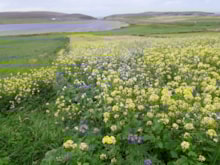
Data is already informing conservation action in Shetland. Through the Species on the Edge programme, land managers across Shetland are being supported in sowing specially-created seed mixes to benefit their local pollinators. Habitat loss is a primary cause of bumblebee decline (with climate change and pesticides being other contributing factors), and these patches of nectar-rich flowers will provide a vital food-source for struggling bumblebees.
The programme is also working with local community groups - raising awareness of Shetland’s bumblebees and their struggles, hosting group survey events, and training and supporting survey volunteers.
Shetland’s bumblebees
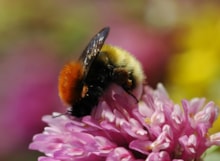
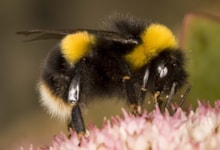
Shetland is home to six species of bumblebee: the White-tailed, Buff-tailed, Garden, Heath, and Early bumblebees, and a rare sub-species of the Moss carder bumblebee, Bombus muscorum agricolae, known here as the Shetland bumblebee.
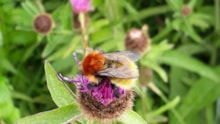
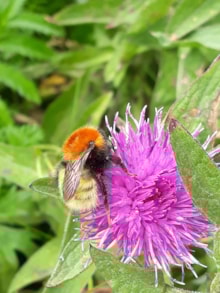
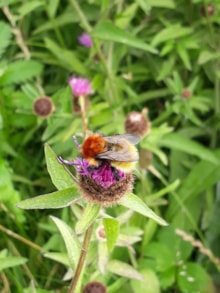
The Shetland bumblebee can be found in Shetland, some of the Scottish Western Isles, and nowhere else in the world. It’s easy to recognise; it has a vivid orange thorax and sunshine-yellow bottom.
The Shetland bumblebee is listed as a vulnerable species on the International Union for Conservation of Nature (IUCN) Red List and is one of the target species for conservation action as part of the Species on the Edge programme.
The Great Yellow bumblebee is another focus species for the programme. Once widespread across the whole of the UK, the Great Yellow can now only be found in Caithness and Sutherland, and a handful of the Scottish western isles. Sadly, the Great Yellow was lost from Shetland around 70 years ago.
People Engagement Officer for Species on the Edge Shetland, Gareth Powell, said: “The Shetland Bumblebee can appear to be the most common bumblebee we have in Shetland, though with little population data, a decline on par with other bumblebees could be hiding in the shadows. One of the crucial things we can all do is to start recording bumblebees in Shetland. With your participation in BeeWalks, that flash of bright orange and the hum of happy wings darting from flower to flower can continue to be something we enjoy this summer, and every summer after.”
Contact information
- Name
- Eilidh Ross
- eilidh.ross@nature.scot
Notes to editors
Species on the Edge is a ground-breaking multi-partner species conservation programme dedicated to supporting vulnerable and threatened species found along Scotland’s coast and islands. Funded by The National Lottery Heritage Fund, the partnership consists of Amphibian and Reptile Conservation, Bat Conservation Trust, Buglife, Bumblebee Conservation Trust, Butterfly Conservation, NatureScot, Plantlife, and RSPB Scotland.
NatureScot is Scotland's nature agency. Responding to the twin crises of biodiversity loss and climate change, we work to protect and restore nature by inspiring everyone to value our natural world. Our goal is a nature-rich, net-zero future for Scotland. For more information, visit our website at www.nature.scot
'S e buidheann nàdair na h-Alba a th’ ann an NàdarAlba. Bidh sinn a’ gleidheadh agus a’ slànachadh nàdar le bhith a’ brosnachadh a h-uile duine gu spèis a chur air an t-saoghal nàdarra againn, agus sinn a’ freagairt air an dà chùis-èiginn de chall bith-iomadachd ’s atharrachadh na gnàth-shìde. ’S e ar n-amas nàdar beairteach ’s cothromachadh carboin do dh’Alba. Airson an tuilleadh fiosrachaidh, thoiribh sùil air an làraich-lìn againn aig www.nature.scot